Improving RO Efficiency Through Intelligent Energy Optimization
Energy consumption is a major operating cost in Reverse Osmosis systems. Even small improvements in operating conditions, hydraulic performance, membrane selection, recovery, and equipment efficiency can significantly reduce specific energy consumption over the life of a plant.
We assess both existing and new RO systems to identify energy-saving opportunities and develop practical optimization strategies. Our approach focuses on reducing specific energy consumption (kWh/m³) while maintaining required permeate quality, recovery, system reliability, and membrane performance.
Lower Energy Consumption. Optimized Performance. Reduced Operating Costs.
Our Approach to Energy Optimization
Our energy optimization methodology begins with understanding how the RO system currently operates. We evaluate process conditions, equipment performance, membrane characteristics, and operating data to identify sources of unnecessary energy consumption.
01 — System Performance Assessment
We review key RO operating parameters including:
This assessment helps establish the current performance baseline and identify areas where optimization may be possible.
02 — Specific Energy Consumption Analysis
We evaluate the energy consumed per unit volume of treated water, typically expressed as kWh/m³.
By comparing actual energy consumption with system requirements and operating conditions, we identify opportunities to reduce specific energy consumption without compromising treatment performance.
Our focus includes:
Lower kWh/m³
Reducing the energy required to produce each cubic metre of permeate.
Optimized Operating Pressure
Identifying opportunities to operate at the required pressure without unnecessary energy consumption.
Improved Recovery
Optimizing recovery while maintaining control over scaling, fouling, and membrane operating limits.
Efficient Water Production
Balancing membrane performance, recovery, pressure, and flow to achieve efficient production.
Existing RO System Optimization
For operating RO plants, we analyze actual plant data and operating conditions to identify opportunities for energy reduction.
Our evaluation may include:
Operating Pressure Optimization
Assessment of feed pressure and membrane operating conditions to determine whether the system is operating above its required pressure range.
Recovery Optimization
Evaluation of recovery levels to identify opportunities for increased water production while managing scaling and fouling risks.
Membrane Performance Evaluation
Assessment of membrane condition, flux, rejection, differential pressure, and normalized performance to determine whether membrane deterioration is contributing to higher energy requirements.
Pump & Hydraulic Assessment
Review of high-pressure pumping and hydraulic conditions to identify potential efficiency improvements.
Process Parameter Optimization
Evaluation of operating parameters and control strategies to improve overall RO efficiency.
Energy Consumption Benchmarking
Analysis of current specific energy consumption to establish a performance baseline and identify potential improvement areas.
New RO Energy-Efficient Design
Energy optimization begins before an RO plant is commissioned.
For new RO systems, we incorporate energy efficiency into the design stage through appropriate membrane selection, system configuration, hydraulic design, recovery optimization, and operating-condition selection.
Membrane Selection
Selection of appropriate membrane elements based on feed-water characteristics, required permeate quality, operating conditions, and system capacity.
Hydraulic Optimization
Optimization of system hydraulics, flow distribution, pressure requirements, and system configuration to minimize unnecessary pressure losses.
Recovery Optimization
Designing recovery around feed-water chemistry and membrane operating limits to achieve efficient water production while controlling scaling and fouling risks.
Energy-Efficient System Configuration
Evaluating system configuration and operating conditions to achieve the required treatment performance with optimized energy consumption.
Long-Term Operating Performance
Our designs consider not only initial energy consumption but also how membrane performance, fouling, scaling, recovery, and operating conditions may affect energy requirements over time.
What We Evaluate
Our energy optimization assessment can consider multiple aspects of an RO system:
Parameter | Optimization Focus |
Feed Pressure | Minimize unnecessary pressure requirements |
Recovery | Maximize water production within operating limits |
Membrane Flux | Maintain efficient membrane operation |
Salt Rejection | Maintain required permeate quality |
Differential Pressure | Identify hydraulic and fouling-related issues |
Pump Performance | Improve energy utilization |
Flow Distribution | Optimize system hydraulics |
Membrane Condition | Reduce energy impact of performance deterioration |
Specific Energy | Reduce kWh/m³ |
Operating Conditions | Improve overall system efficiency |
Energy Optimization & Membrane Performance
Energy consumption cannot always be addressed by simply reducing operating pressure.
Membrane fouling, scaling, aging, poor hydraulic conditions, inappropriate recovery, and declining membrane performance can all influence the pressure and energy required to operate an RO system.
That is why our approach considers energy consumption together with membrane and process performance.
By identifying the underlying causes of increased energy demand, we can develop optimization strategies that improve efficiency while protecting membrane performance and treated-water quality.
Benefits of Energy Optimization
A well-optimized RO system can provide improvements across several areas:
Reduced Specific Energy Consumption
Lower energy requirements per cubic metre of treated water.
Lower Operating Costs
Reduced electricity consumption can contribute to lower overall RO operating costs.
Improved System Efficiency
Better coordination of pressure, flow, recovery, and membrane performance.
Optimized Water Recovery
Increased water production while maintaining appropriate control of fouling and scaling.
Improved Membrane Performance
Operating conditions optimized around membrane requirements can support stable long-term performance.
Better Process Control
Improved understanding and control of the parameters that influence energy consumption.
Sustainable Water Treatment
Reducing energy consumption contributes to more resource-efficient water treatment operations.
Our Energy Optimization Process
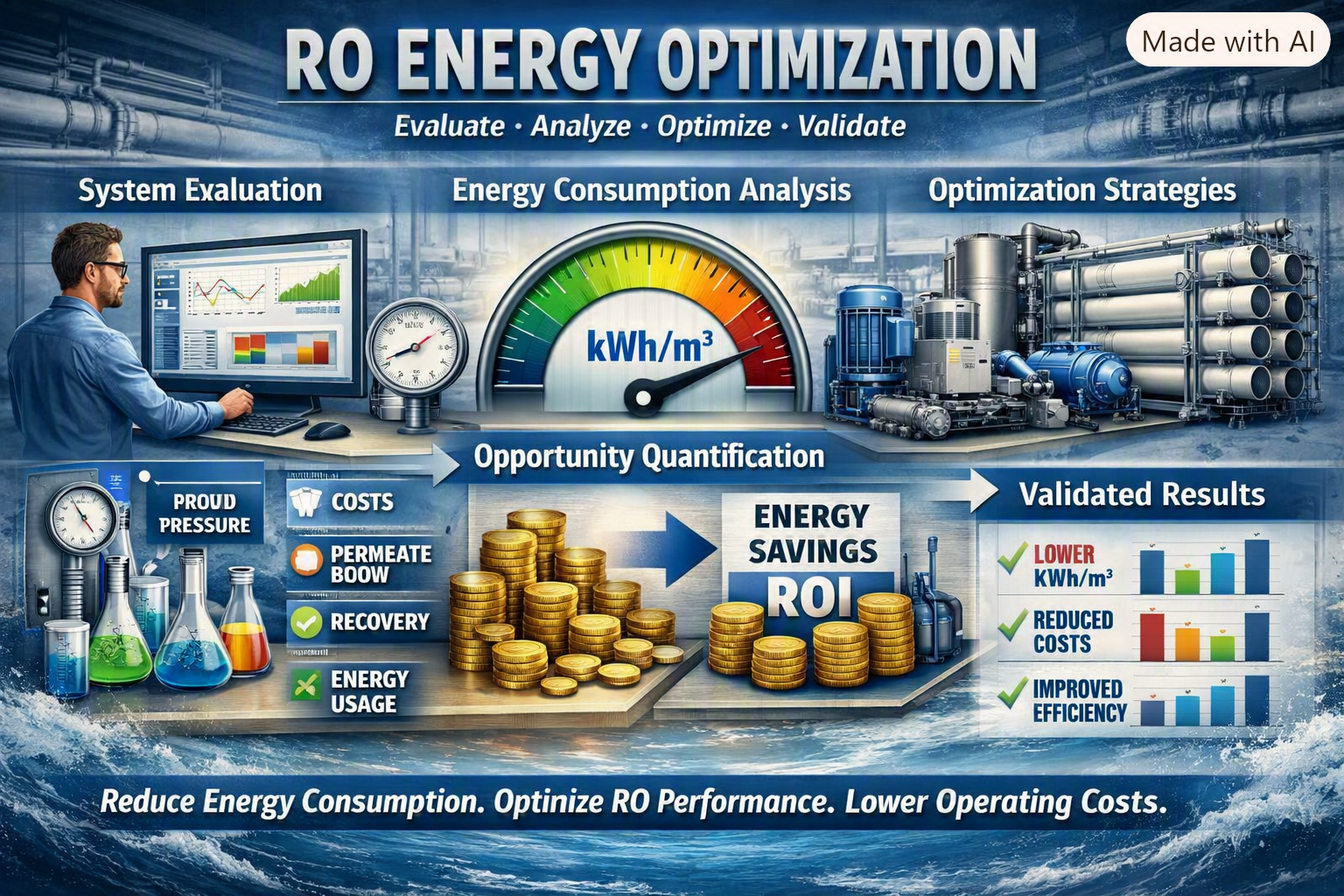
Assess → Analyze → Optimize → Validate
Assess
Collect and evaluate plant operating data, equipment performance, membrane condition, and process parameters.
Analyze
Identify energy-intensive operations, performance gaps, hydraulic losses, and optimization opportunities.
Optimize
Develop practical changes to operating conditions, recovery, membrane configuration, hydraulics, and equipment operation.
Validate
Monitor system performance after optimization to evaluate energy savings, water production, permeate quality, and overall operating stability.
Sustainable Energy-Efficient RO
Energy efficiency is an important part of sustainable water treatment.
Our optimization approach aims to reduce energy consumption and operating costs while maintaining reliable water production and consistent treated-water quality.
By improving RO system efficiency, optimizing operating conditions, and designing systems with long-term performance in mind, we help industries make better use of both water and energy resources.
Why Optimize Your RO System?
An RO plant may continue to produce water while operating significantly below its optimal efficiency. Changes in feed-water conditions, membrane performance, recovery, fouling, scaling, or equipment operation can gradually increase energy consumption.
Regular performance assessment can help identify these changes before they become larger operational issues.
Optimize Your RO System for:
Lower kWh/m³
Reduced Operating Costs
Higher Water Recovery
Stable Permeate Quality
Efficient Membrane Operation
Long-Term System Reliability
Let’s Optimize Your RO System
Whether you are operating an existing RO plant or developing a new system, our energy optimization services can help identify opportunities to improve efficiency and reduce specific energy consumption.
From performance assessment to energy-efficient RO design, we develop optimization strategies around your plant, process requirements, and operating conditions.
Optimize Performance. Reduce Energy. Improve Efficiency.
HEMMSTOFF Environmental Services provides reliable water and wastewater treatment solutions, combining engineering expertise, practical knowledge, and sustainable practices for long-term performance.